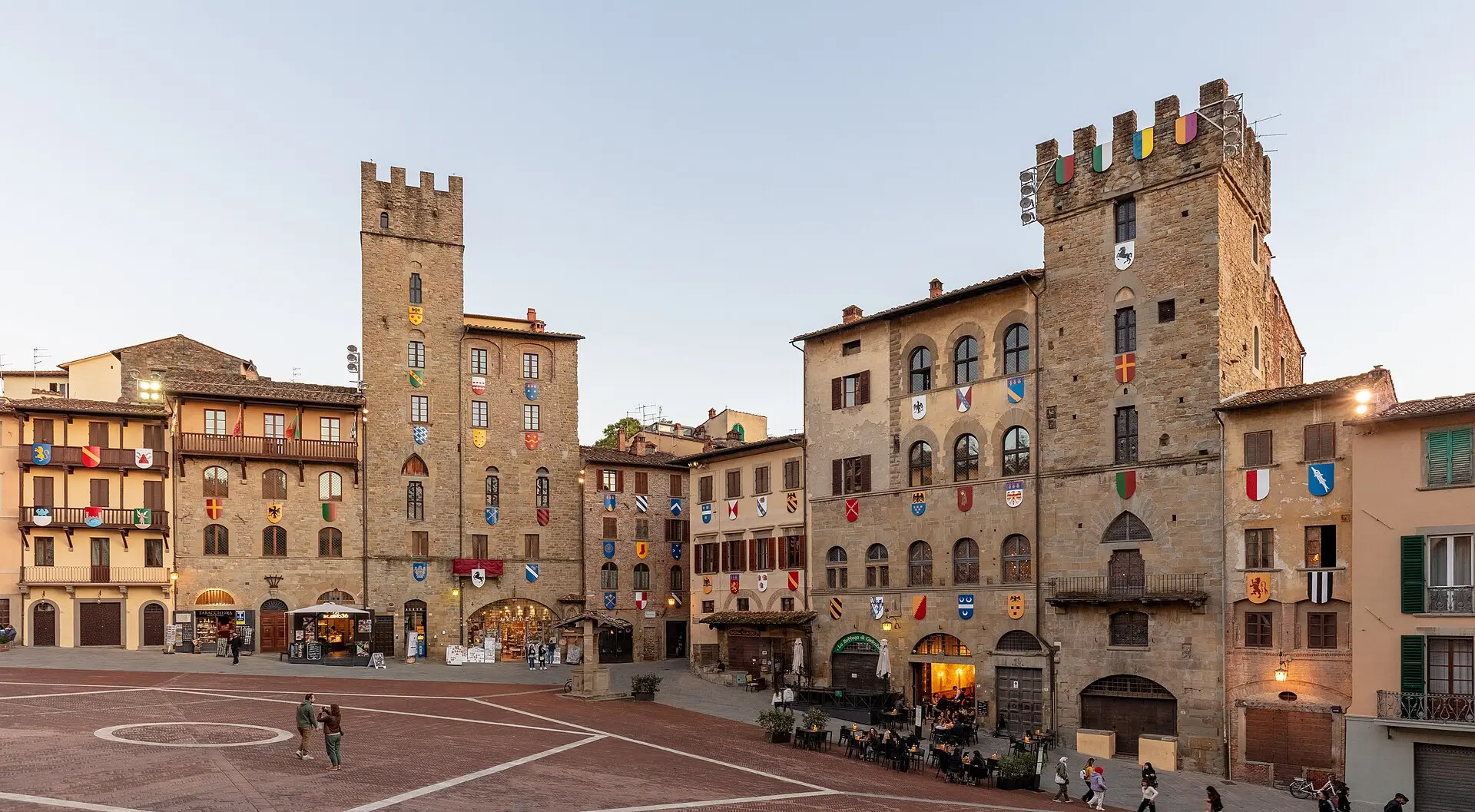
What the Giostra is
The Giostra del Saracino, the Joust of the Saracen, is run in Piazza Grande twice a year: on the second-to-last Saturday of June, in the evening, for San Donato, the city's patron saint, and on the first Sunday of September for the Madonna del Conforto. Porta Crucifera, Porta del Foro, Porta Sant'Andrea and Porta Santo Spirito each send two knights against the Buratto, the King of the Indies, and the quarter that scores the most points takes home the Golden Lance.
For people from Arezzo it is not a re-enactment: it is the quarter they grew up in, its colours and the count of lances, argued about all year round. That count is right above, updated after every joust.
How to win
Each quarter has two knights and each runs one charge: he gallops along the lizza, the strip of earth that crosses the square diagonally, and with a wooden lance 3.55 metres long strikes the shield of the Buratto. The shield carries a board divided into sectors: the centre is worth 5 points, the others from 4 down to 1.
Once hit, the Buratto spins round and swings its flail, three wooden balls covered in leather. A knight struck by them loses 2 points, and so does one who takes longer than 4.85 seconds. Breaking the lance doubles the points, dropping it loses them all.
After the two charges the quarter with the most points wins; in case of a tie, play-off charges are run. The rector of the winning quarter receives the Golden Lance, which the crowd carries in procession to the Cathedral and then to the quarter's home, where the celebrations go on for days.
A quarter that wins both jousts of the same year scores a cappotto.
The week of the Giostra
The lizza and the Buratto arrive in Piazza Grande a week before, for the horses to train, and seven days before the order of the charges is drawn at the town hall. On the Thursday before the June Giostra and the Friday before the September one there is the dress rehearsal, the provaccia: everything as on the day, but without costumes and with the reserve knights. They say whoever wins the provaccia loses the Giostra.
In the ten days before, each quarter fills its streets with dinners and parties, up to the good-luck dinner on the eve, with more than a thousand people at the table in each quarter. On the day, before the charges, the flag-wavers, the musicians and the historical parade of more than three hundred people in costume enter the square. The herald reads the Challenge of Buratto and the whole square sings the anthem.
From the Middle Ages to today
Jousts were already run in Arezzo in the Middle Ages: Dante recalls the jousts of the Aretines in canto XXII of the Inferno, and the oldest record of a tournament in Piazza Grande dates from 1260. In 1535 the city decided to joust against the Buratto for the feast of San Donato, and the rules written for a joust in 1677 are still the basis of today's.
The modern Giostra was born on 7 August 1931, the feast of San Donato. The first one was run by five districts and won by Porta Burgi; the following winter the city went back to the four quarters of the old gates, the ones that still compete. It stopped from 1941 to 1947, for the war and the reconstruction, and again in 2020 and in June 2021, for the pandemic. There have also been five extra editions outside the usual dates, the last in 2016 for the Jubilee of Mercy.